Overview
We focus on developing analog/RF/mmWave integrated circuits and micro-systems for wireless communications, sensing, and biomedical applications. In these applications, energy efficiency, bandwidth, size, and security are critical performance metrics. Our research aims to extend the boundaries of these metrics and enable exciting new applications at the hardware level, by leveraging innovations in application-specific integrated circuits (ASIC) design, advanced electromagnetics, and their tight integration. Specifically, our work involves (i) conducting theoretical analysis of circuit problems, (ii) developing new hardware capabilities, and (iii) performing system-level engineering. A few recent research efforts are highlighted below.
mmWave / sub-THz Transceivers for 5G and Beyond
A significant shift in 5G communications is moving up the carrier frequency to mmWave, leading to a 10× increase in the available bandwidth and resulting data throughput. As 5G deployment continues, one potential 6G under discussion aims to further increase the frequency to 100+ GHz. To truly harness mmWave/sub-THz bands in large-area networks, we need to satisfy three system requirements simultaneously – wide network coverage, high bandwidth, and support for high user mobility. Towards this end, we are interested in energy-efficient, wideband, and reconfigurable transceiver building blocks, antennas, and beamforming systems. Related Publications:
- Building Blocks
- Front-end Module: ISSCC 2025
- Power Amplifier: JSSC 2024, ISSCC 2024, T-MTT 2024, CICC 2023, JSSC 2023, RFIC 2022
- LO Generator and Oscillator: T-MTT 2025, ISSCC 2025, CICC 2023
- Low-Noise Amplifier: MWTL 2023, T-CAS I 2023, MWCL 2021
- Systems
- D-band Antenna Array: CICC 2025, RFIC 2023
- Hybrid Beamformer: JSSC 2024, CICC 2021
- Full Duplex: JSSC 2018, ISSCC 2018
- 100-300GHz Broadband TRX: ISSCC 2017

Antenna-Electronics Co-Design
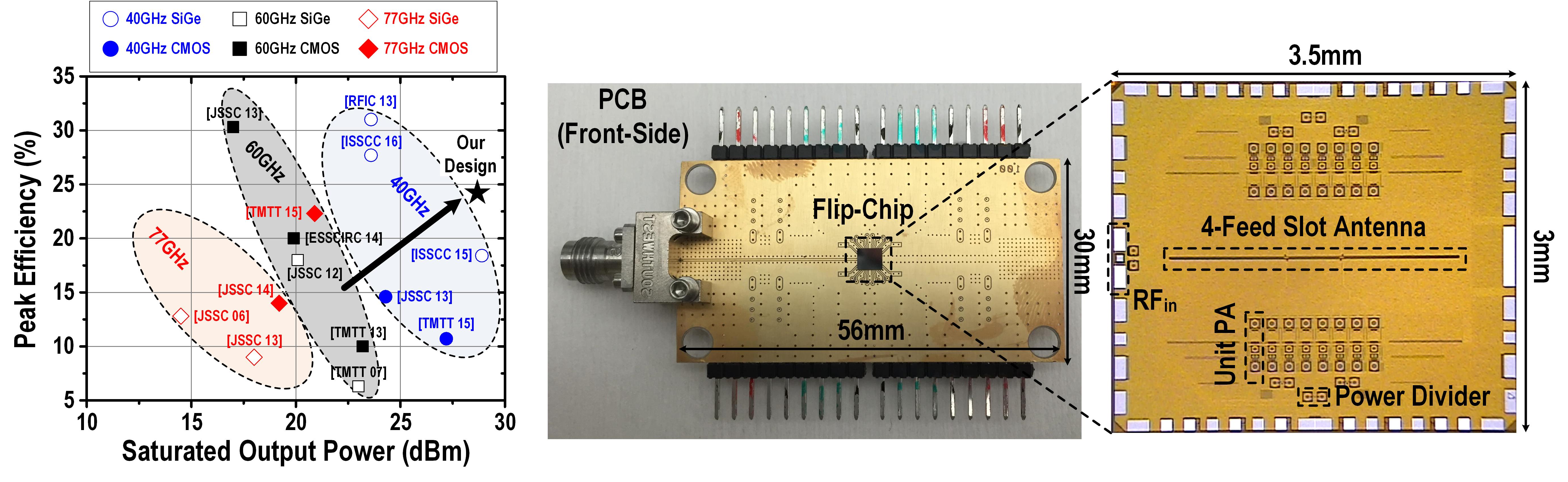
Conventionally, antennas and electronics are often treated as two distinct and separate domains: antenna designers handle the antennas; circuit designers deal with the electronics; and they only talk to each other over one single standard 50Ω interface. However, this partitioned approach may not lead to a globally optimal design if we artificially impose a boundary between antennas and electronics. It is noteworthy that the far-field antenna radiation characteristics are completely governed by its local current or voltage distributions, suggesting the possibility of actively synthesizing the desired antenna responses using multiple antenna feeds. Multi-feed antennas co-integrated with complex electronics now emerge as a promising technology to enable drastic performance improvement and additional functionalities for transceiver frontend. Related Publications:
- On-Antenna Power Combining: ISSCC 2017, T-AP 2017
- On-Antenna Load Modulation: JSSC 2019, RFIC 2018, ISSCC 2018
Neuro-engineering
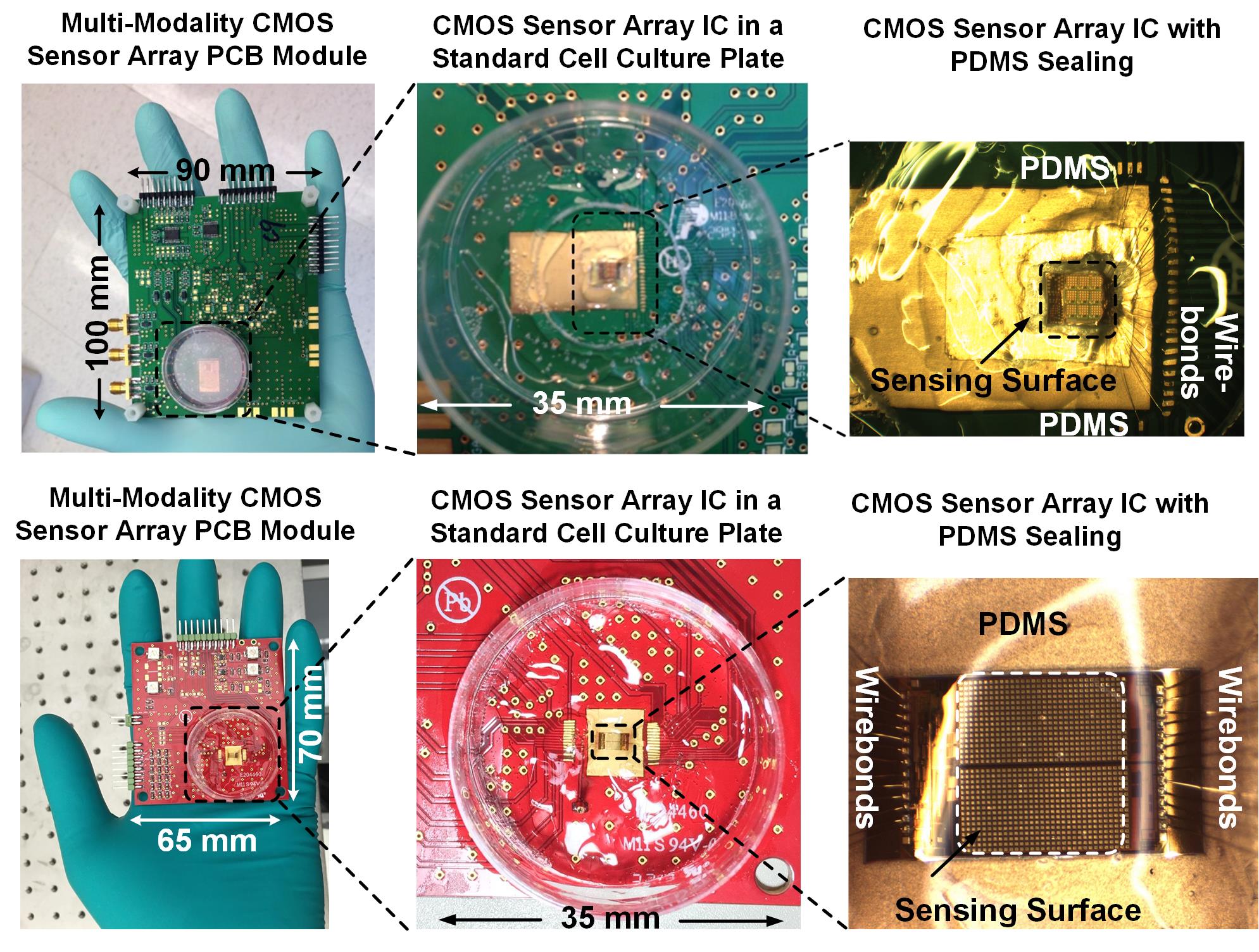
A major technological need to further advance brain science is to develop neural interfaces that can record and stimulate neural activity across a large number of neurons and across all relevant time scales. Emerging brain-machine interfaces built on large-scale neural recording can decipher brain activities; the decoded information can then be used to control neural prosthetics to restore lost sensory or motor functions for paralyzed patients. On the neural stimulation side, deep brain stimulation (DBS) has proven to be highly effective in treating brain disorders (such as Parkinson’s disease) by injecting a pulsed current with a pre-defined pattern. In collaboration with Rice Neuro-engineering Initiative and Texas Medical Center, we are interested in developing new methodologies and hardware interfaces for neural recording and stimulation. Related Publications:
- In Vitro Recording and Stimulation: T-BioCAS 2021, ISSCC 2021, T-BioCAS 2015, ISSCC 2015
- Minimally Invasive Neural Stimulation: ISSCC 2024, JNE 2022
- Non-Invasive Intracranial Pressure (ICP) Monitoring: T-BioCAS 2024, ISSCC 2024
Wireless Physical-Layer Security
While the wide adoption of 5G and IoT has opened up various new applications, their network complexity and inherent resource constraints also bring unprecedented security challenges that require innovative solutions. Wireless physical-layer security has great potential for carrying out low security-level tasks (such as identification) and complementing digital cryptography for more advanced primitives (such as multi-factor authentication). In collaboration with Prof. Kaiyuan Yang’s group, we are interested in developing low-overhead hardware security solutions that can be directly embedded in transceiver frontends to enable physical-layer security protection. Related Publications:
- Physical-Layer Identification (a.k.a. RF Fingerprinting): T-MTT 2024, ICC 2024, ISSCC 2021
- MmWave TX array against eavesdropping attacks: ISSCC 2026, T-MTT 2025
 Rice Integrated Systems and Electromagnetics (RISE) Lab